
Our kids are adapting… but to what?
BY DORTE BLADT
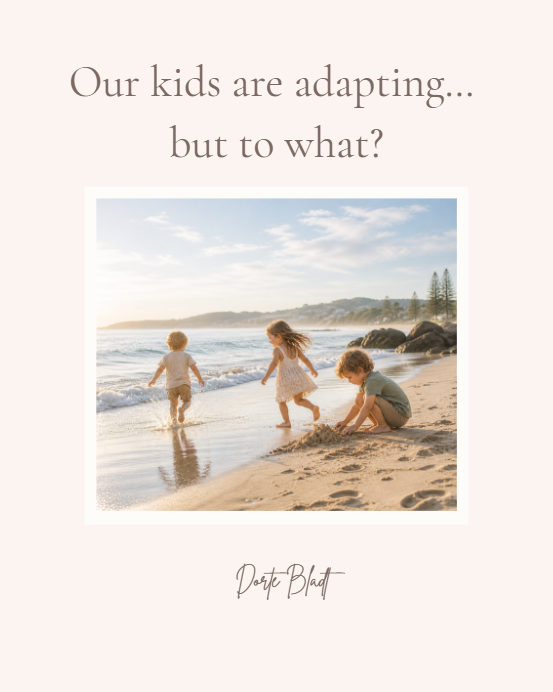
I was walking along the coastal path on one of those breathtaking Australian autumn days.
The sun was warm, the sky impossibly blue, and the ocean rolled gently onto the white sand below. Birds circled overhead, dogs trotted happily on their leads, and children rode past on their bikes. Above the hill, colourful hang gliders lifted into the air, and, just to complete the scene, an aerobatics plane traced playful loops across the sky.
It was one of those moments where you can’t help but feel grateful to be outside, immersed in it all.
And then, walking towards me, came a parent pushing a double stroller.
Two young children sat side by side—each with a device clamped directly in front of their face.
The contrast was striking.
Earlier that morning, I had come across an article that caught my attention about the shape of the human eyeball changing.
Traditionally, the eyeball reaches its full size by early adulthood. However, increased time spent on near work, such as screens, books and devices, may be contributing to the eye becoming more elongated. This change in shape affects how the eye focuses, making it harder to see clearly in the distance. This is known as short- sightedness or myopia.
That was the science.
But as I walked along the beach that morning, I found myself viewing it through a different lens. From a broader perspective, this is also a powerful example of how adaptable the human body is.
Our bodies are constantly responding to the environment around us. They are not static. They are dynamic, intelligent and always adjusting to meet the demands placed upon them.
The changes being observed in the eye are not random.
They are a reflection of what the body is being asked to do, over and over again.
And in that sense, the body is doing exactly what it is designed to do.
The challenge, of course, is that not all adaptations serve us well in the long term.
While short-sightedness might seem like a minor inconvenience - something easily managed with glasses - the broader implications are more significant. Myopia is now recognised as a leading contributor to vision impairment worldwide, and in more severe cases is associated with increased risk of eye health conditions later in life.
Children are particularly vulnerable.
Their eyes are still developing, and the environment they grow up in plays an important role. Extended periods of close-up focus, combined with less time outdoors and reduced exposure to natural light, all influence how their vision develops.
And the trend is growing.
In Australia, close to 30% of children are now short-sighted. In North America, rates have doubled over the past 50 years. In parts of Asia, the numbers are 80-97%.
Globally, it is predicted that by 2050, around half the world’s population may be affected.
When you look at how children spend their time today, it’s not hard to see why.
Many children are spending several hours each day on screens, often well beyond what previous generations experienced. And that’s before factoring in school-related screen use.
Our children’s bodies are adapting exactly as they are designed to do.
The question is—what are they adapting to?
The encouraging news is that small, simple shifts can make a meaningful difference.
Time spent outdoors is one of the most powerful influences on healthy development.
Natural light, open spaces, movement and the opportunity to look into the distance all support not just vision, but overall wellbeing.
Children don’t need complicated solutions.
They need time to move, explore, climb, run, imagine… or simply be.
When close-up work is part of the day, building in small breaks can help. A simple guideline often recommended is the 20-20-20 rule: every 20 minutes, look at something in the distance (around 20 feet away) for 20 seconds.
Small changes. Meaningful impact.
That moment on the beach stayed with me.
A world full of colour, movement, light and life… and two little ones experiencing something very different.
Our children’s bodies will always adapt. And that is something to be grateful for.
The opportunity - and the responsibility - we have, is to shape the environment they are adapting to.
Every child is unique, and sometimes it’s helpful to have someone to talk things through with. If you’d like guidance or reassurance around your child’s development, we’re here to help.
The Family Chiro
